Data Science · Web Application
University
Recommendation
App
Empowering international students to navigate the overwhelming university application process through data-driven insights and intelligent recommendations.
Role
Data Scientist & Web App Designer
Timeline
Fall 2024 (DESIGNTK 530)
Tools
Python, Streamlit, Figma, VS Code
Links
The Challenge
The university application process is overwhelming for international students. With thousands of institutions offering varying programs, scholarship opportunities, and acceptance rates, how do you make an informed decision? I personally experienced this challenge—applying to over 15 universities without clear data to guide me. This project was born from that frustration.
Problem Statement
How might we empower international undergraduate and graduate students to navigate the complex university application process by providing data-driven insights that simplify school selection and improve application success rates?
Background & Research
I approached this as both a data scientist and web app designer, analyzing trends in application success rates, scholarship opportunities, and institutional dynamics. The goal? Create a tool that provides personalized, real-time insights to help students select suitable institutions while maximizing their chances of admission and scholarships.
Addressing Complexity
Simplify the overwhelming application process through data analysis
Data-Driven Decisions
Provide personalized insights for better school selection
Global Impact
Promote resource efficiency and support education access
Design Rationale
I centered the design around three core principles that would make the app both reliable and valuable to students:
Reliable AI/ML Model
The app needs a robust and trustworthy machine learning model that can accurately process user preferences and provide reliable recommendations.
Right Metrics from Dataset
Carefully selecting appropriate metrics from the dataset is crucial to building an effective recommendation model that aligns with user needs.
Empower Students
The overarching goal is to provide students with the necessary tools, information, and personalized recommendations to support their university selection process.
Application Flow
I designed a streamlined workflow that takes natural language input from students and transforms it into actionable university recommendations through KMeans clustering and Gemini API integration.
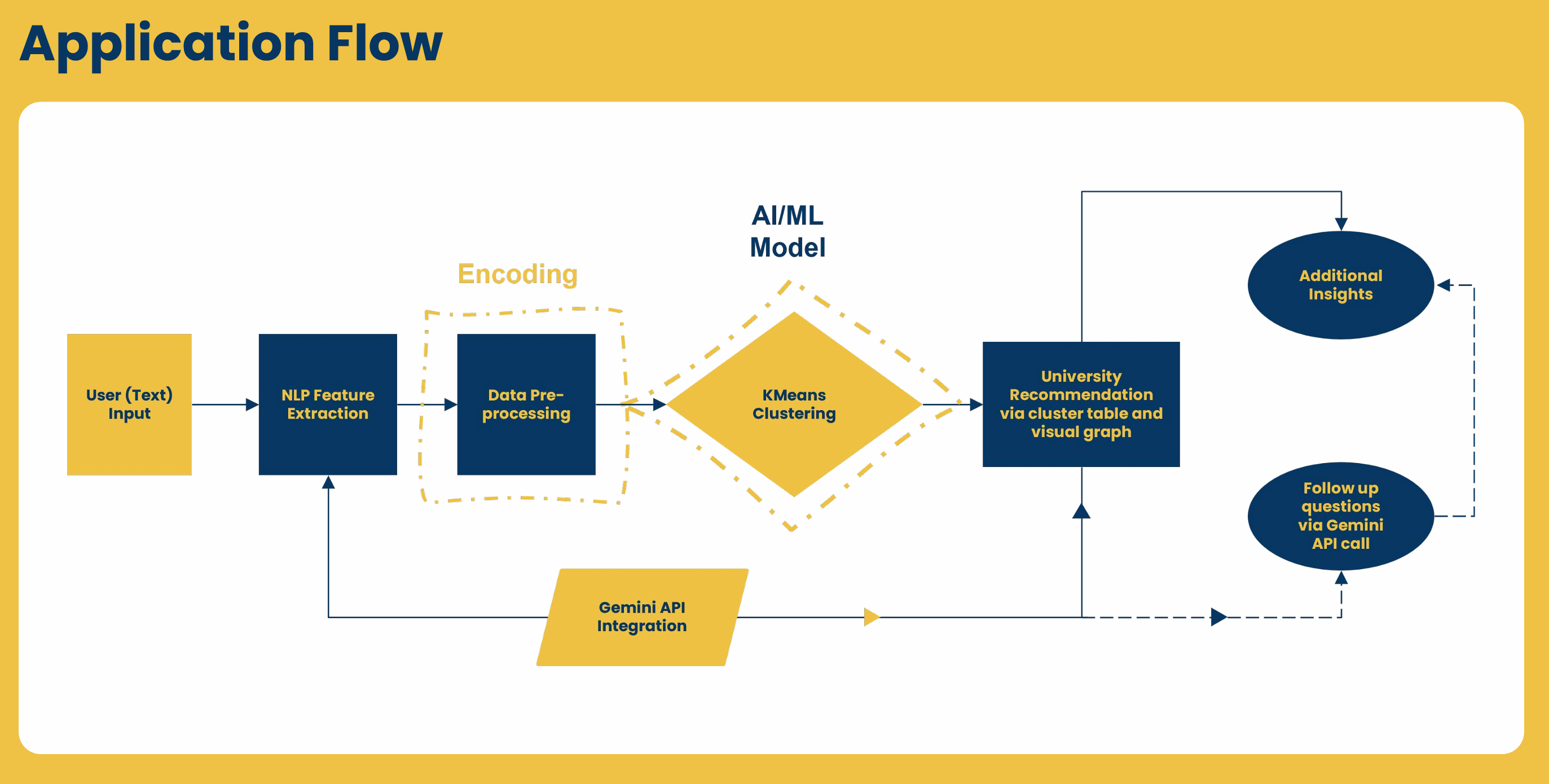
User Input (Text)
Student describes preferences in natural language
NLP Feature Extraction & Data Preprocessing
Extract key metrics and prepare data for clustering
KMeans Clustering (AI/ML Model)
Group universities by similarity across key dimensions
Recommendations via Cluster Table & Visual Graph
Present results in table and 3D scatter plot format
Follow-up via Gemini API
Provide additional insights and answer student questions
What the App Achieves
I prioritized user experience with a clean, intuitive interface that makes university data accessible. Here's what makes the app effective:
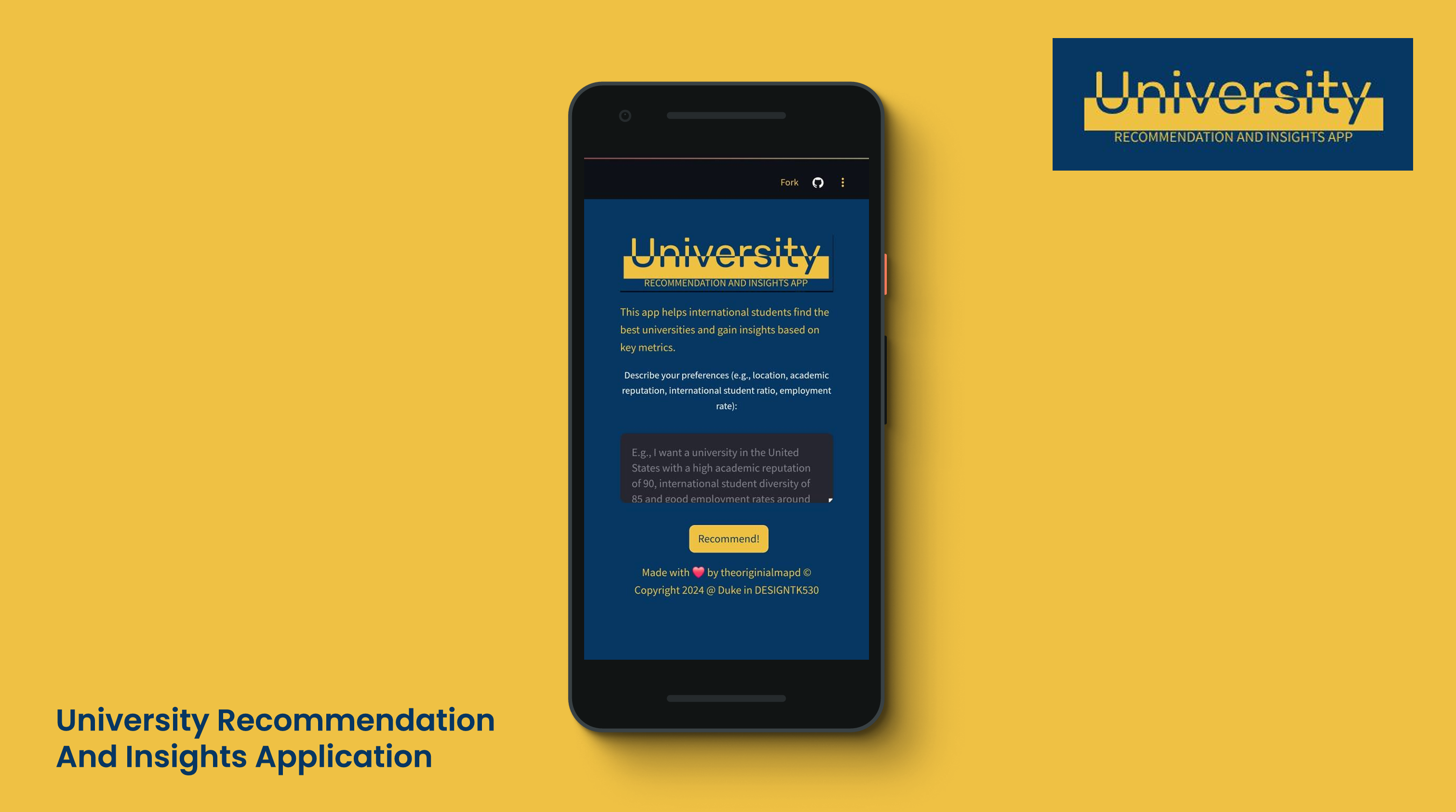
User Input
A clear text area prompts users to describe preferences regarding location, academic reputation, international student ratio, and employment rates—with example formats to guide input.
"Recommend!" Button
A prominent button encourages users to submit preferences and initiate the recommendation process.
Visual Appeal
The app utilizes a clean design with dark background and contrasting text colors. Simple, bold fonts enhance readability.
Clear Instructions
The text area includes placeholder examples to guide users on formulating preferences, ensuring accurate input and better results.
Brand Identity
The footer includes copyright notice and attribution, adding a professional touch and fostering trust.
Challenges & Solutions
Data Quality
Challenge: Inconsistencies and missing values in the dataset threatened recommendation accuracy.
Solution: Implemented thorough data cleaning and preprocessing techniques to ensure reliability.
Feature Engineering
Challenge: Identifying which university attributes matter most to students.
Solution: Created relevant features for clustering by encoding categorical variables and normalizing numerical features.
Model Selection
Challenge: Finding the right clustering algorithm for diverse university profiles.
Solution: Evaluated different clustering algorithms and selected KMeans as most suitable for the given dataset.
User Interface Design
Challenge: Making complex data accessible to non-technical users.
Solution: Prioritized user experience by designing a clean and intuitive interface with clear instructions.
API Integration
Challenge: Providing personalized insights beyond clustering results.
Solution: Successfully integrated the Gemini LLM API to provide contextual information and answer follow-up questions.
What I Learned
This project taught me how to bridge the gap between data science and user-centered design. Building a tool that solved my own problem—finding the right universities to apply to—made me deeply invested in creating something genuinely useful.
I learned that technical excellence means nothing if users can't understand or access your solution. The challenge wasn't just building a clustering algorithm—it was translating complex statistical outputs into clear, actionable recommendations that empower students to make confident decisions about their futures.
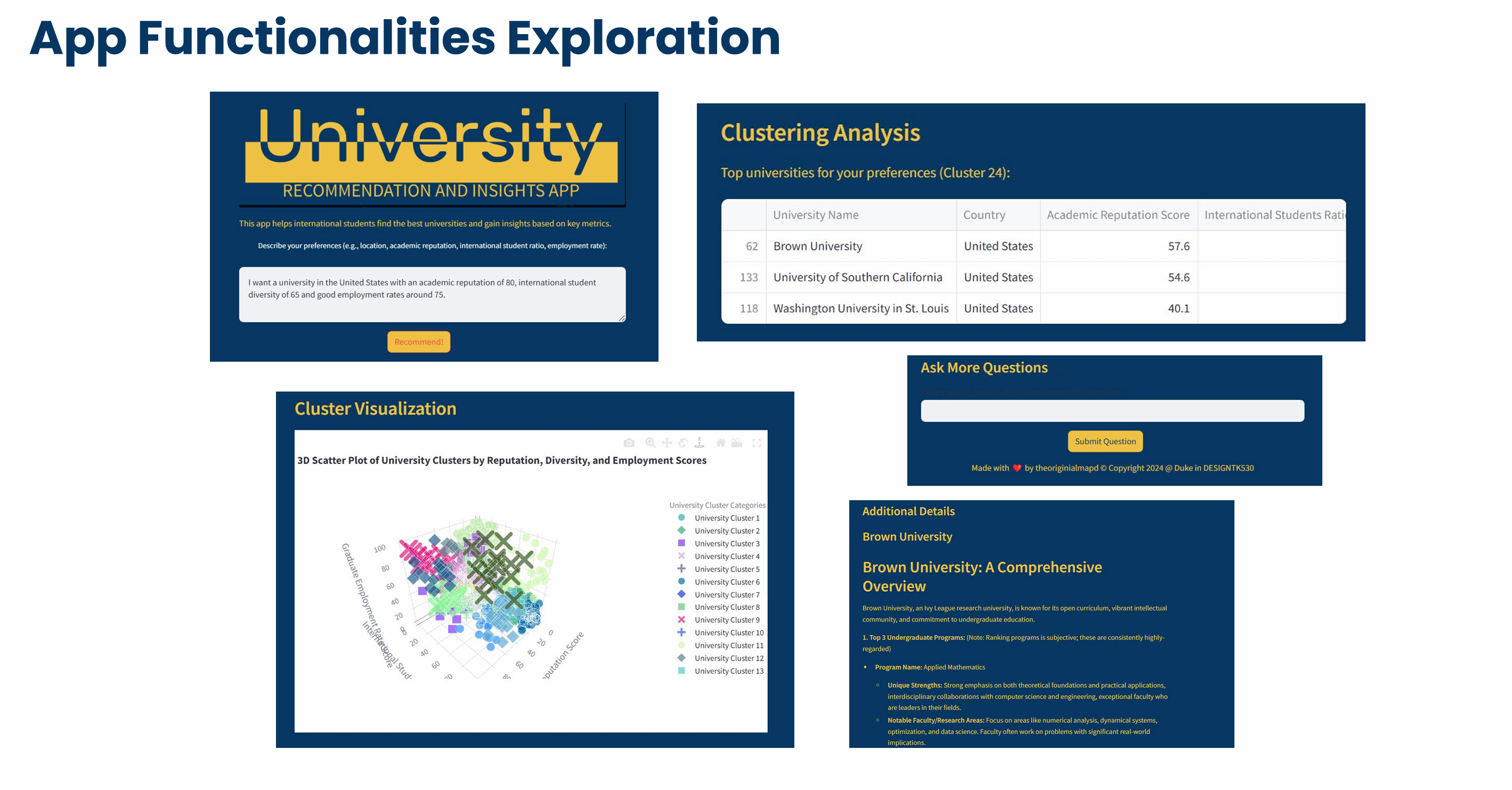
App Functionalities Exploration
Clustering Analysis
KMeans algorithm groups universities by reputation, diversity, and employment scores—displayed in table format
Cluster Visualization
3D scatter plot visualizes university clusters, making complex patterns immediately understandable
Additional Insights
Gemini API integration provides detailed university overviews, program information, and research opportunities
Follow-up Questions
Users can ask specific questions about recommended universities to get personalized guidance
13 December 2025: Full Platform Evolution
Latest UpdateAfter extensive user feedback and iteration, I evolved the app from a simple recommendation tool into a comprehensive 6-page intelligent platform that guides students through the entire university application journey. The new version features ML-powered discovery, timeline generation, scholarship finding, competitiveness analysis, and 24/7 AI assistance.
New Platform Features
🎯 Smart Discovery
K-Means clustering with 3D visualization and AI insights
📋 Application Journey
12-month timeline and 18-item interactive checklist
💰 Scholarship Finder
AI-powered funding search with ROI calculator
📊 Success Insights
5-tier competitiveness analysis and predictor
🤖 AI Assistant
24/7 contextual chat with comprehensive guides
🎨 Design System
WCAG AAA compliant (21:1 contrast ratio)
Browse through the new platform (1 of 6)
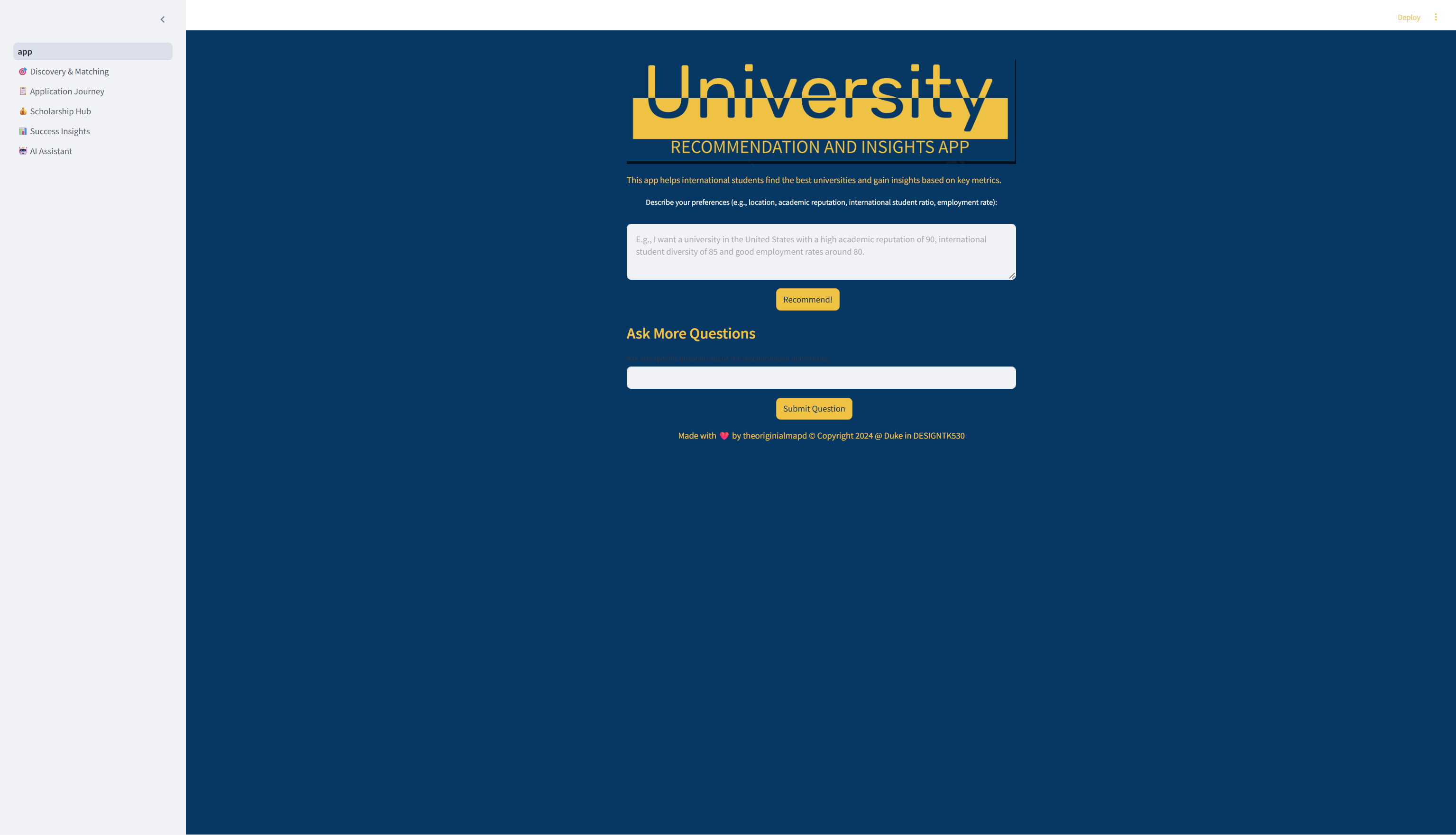
New iteration - Discovery page with ML-powered university matching
Personalized university recommendations based on student preferences
Future Improvements
Expand Dataset
Incorporate data from additional sources to improve recommendation accuracy
Enhanced Clustering
Explore advanced clustering techniques to refine university grouping
Additional Features
Add scholarship information, cost of living data, and rankings from other sources
Cloud Deployment
Deploy to cloud platform to make the app accessible to a wider audience